
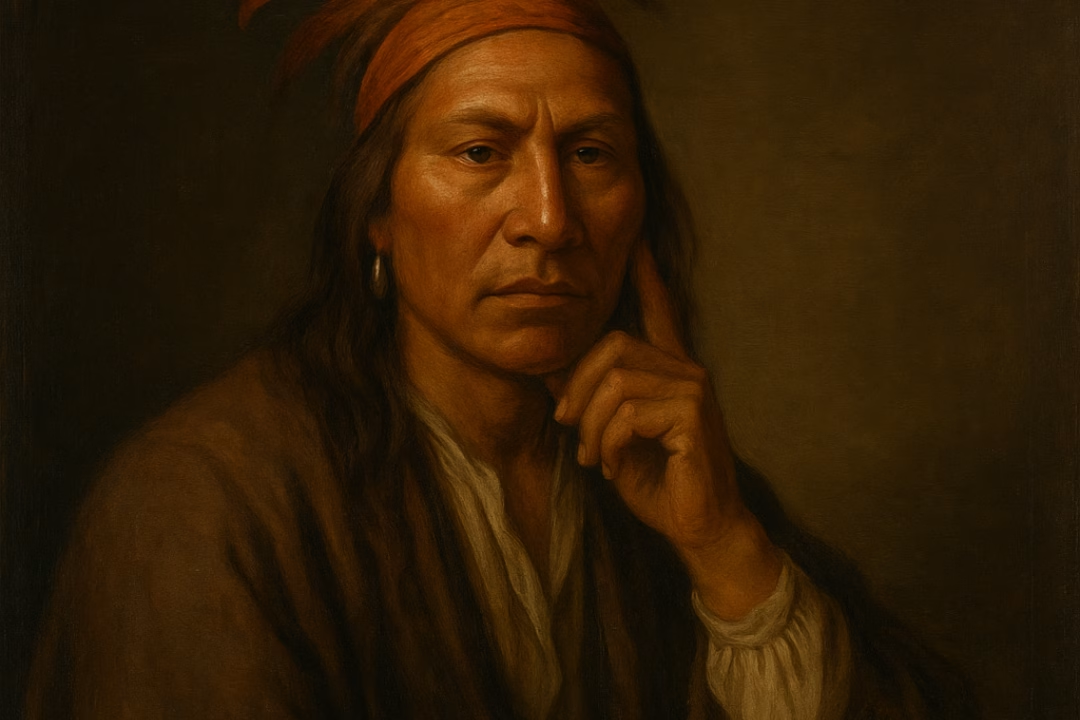
The United States invented democracy, along with the concepts of equality, freedom, justice—or at least that’s probably the idea you got from learning history in secondary school. Maybe your western “civ” class in college gave the impression that things are a bit more complicated. That the Greeks invented democracy and that European philosophers in fact came up with all the great ideals that Fox News exclusively attributes to America. Being a history major I’m ashamed to admit that I generally adhered to the western narrative that the key concepts of equality, justice, and democracy in all of its various guises did in fact emanate from a European tradition. As much of the world already knows, there have been philosopher-intellectual types all over the world—not just Europe—passing down their wisdom from a variety of cultures, but even until recently I tended to associate the idea of a philosopher with a wizened old person writing down their beliefs for future generations. A recent book by the late David Graeber and David Wengrow, The Dawn of Everything, massively challenged all my preconceived notions about what makes a philosopher. Their work also illuminates the way in which new ideas can be generated when different cultures come into contact for the first time and, most importantly for this post, introduced me to Kandiaronk.
As much of the world already knows, there have been philosopher-intellectual types all over the world—not just Europe—passing down their wisdom from a variety of cultures
Kandiaronk was a Native American Chief of the Wendat people. His name translates to muskrat, and his French interlocutors somewhat affectionately dubbed him “Le Rat.” Kandiaronk was born in 1625 and died in 1701. This was a period of great upheaval for the Wendat. Situated between Lakes Huron and Michigan, the Wendat found themselves frequently at odds with the Haudenosaunee (Iroquois) nation as well as the newly arrived French colonizers. He frequently engaged in a sophisticated diplomacy intent on pitting the Haudenosaunee against the French, a tactic that diverted their attention from Wendat lands. Beyond his noted diplomatic skill, Kandiaronk gained a reputation among the French and other Native Americans as having a brilliant mind.
Graeber and Wengrow purposely introduce Kandiaronk as an intellectual and philosopher. This took me aback when I first read their book. Having been schooled in the western tradition, my idea of an intellectual has always been closely tied to writing. If someone isn’t writing down their philosophy then how can they be a philosopher? I suck, but I’m always looking to suck less and their deliberate recognition of Kandiaronk as a great intellectual was a refreshing and welcomed perspective. Aside from Kandiaronk being a very important figure in North American history, why did Graeber and Wengrow decide to feature him in their work? They included Kandiaronk because to them at least, he’s very likely responsible for the modern concepts many of us hold so dear today—how equality, justice, and democracy should ideally operate in a society. It wasn’t Plato, Jefferson, or Hamilton that defined the ideal free society. It was Le Rat.
Kondiaronk’s interactions with Europeans helps to highlight the phenomenon of cultural schismogenesis. This is a process in which cultures develop in relationship to and in opposition to one another. For one example, the authors point to Native American tribes on the west coast of the United States. Human enslavement took hold in many of the tribes in the Pacific Northwest, and this extended down the coast to northern California. These peoples, the Haida and Tlingit among others, celebrated abundance and used enslaved people to perform the annual salmon harvests. Strangely, tribes in northern California, where resources were similar, adopted an austere lifestyle and loathed the act of enslavement. The authors argue that these differing systems of social organization developed in opposition to one another, the classic “I will not be like them, I will be utterly different” mindset. It’s also an example of how ideas and beliefs are generated and evolve over time through human interaction.
The French explorer and philosopher Baron Louis-Armand Lahontan met Kandiaronk in the late 1600s. He was fascinated by the Wendat’s Chiefs oratory skills. Kandiaronk gained a reputation for being an amazing debater, so much so that as an ally of the French he was invited to visit France and the court of the French king, giving the Wendat chief a chance to see how his French allies lived. This ultimately led Lahotan to record his discussions with Kandiaronk on such topics as religion and sociology, things we all like to chat with our family about. More importantly it was a written record of two cultures morally assessing one another—schismogenesis in one volume. It was eventually published in Europe as New Voyages to North America. Kandiaronk did not temper his opinions on European life, especially as it pertained to property, or wealth:
I have spent 6 years reflecting on the state of European society and I still can’t think of a single way they act that is not inhuman and I generally think this can only be the case as long as you stick to your distinctions of “mine” and “thine.” I affirm that what you call “money” is the devil of devils, the tyrant of the French, the source of all evils, the bane of souls and slaughterhouse of the living. To imagine one can live in the country of money and preserve one’s soul is like imagining one can preserve one’s life at the bottom of a lake. Money is the father of luxury, lasciviousness, intrigues, trickery, lies, betrayal, insincerity—of all the world’s worst behavior. Fathers sell their children, husbands their wives, wives betray their husbands, brothers kill each other, friends are false—and all because of money. In light of all of this, tell me that we Wyandotte are not right in refusing to touch or so much as look at silver.
On the subject of religion he was just as strident:
Having thought long and hard over the course of a decade about what the Jesuits have told us about the Great Spirit, any Wendat could give you twenty reasons against the notion. For myself, I’ve always held that, if it were possible that God had lowered his standards sufficiently to come down to earth, he would have done it in full view of everyone, descending in triumph, with pomp and majesty, and most publicly…He would have gone from nation to nation performing mighty miracles, thus giving everyone the same laws. Then we would all have had exactly the same religion, uniform spread and equally known throughout the four corners of the world.
Lohatan’s book disseminated Kandiaronk’s thoughts throughout the literary salons of Europe. He forcefully critiqued the ways in which Europe had structured their society. He also had no patience for condescending Europeans proselytizing for their way of life. He was quick to ask them why they didn’t take a closer look at how the Wendat lived. Maybe they could take some inspiration from them instead? Over time the interpretation of these dialogues was white washed. European scholars determined that no Native American could possibly have posed such logical and cogent criticism. Instead it had to be a European using a Native American as a vessel to critique their own society. And this is the part of Graeber and Wengrow’s work that really challenged me. They reminded me of how I was taught about early encounters between Europeans and Native Americans in North America. The Native Americans are always portrayed as naive and innocent in some sense. The Europeans are the wise cynics who hold a secret knowledge that contains the keys to true power. True dominance. They are dealing with children. Admirable in ways, but out of their depth in all the others.
The authors describe Kandiaronk as a North American philosopher. They accept that the record of these conversations is authentic, because there’s no reason to assume they are not. They also point to a substantial amount of evidence showing numerous critiques of European society by native people, not just Kandiaronk. The conversations recorded by Lahotan were not a special case, but instead common at this time. It just so happened that Le Rat was quite good at dismantling the logic of the European social order. From here they make a rather larger claim, that these dialogues, in addition to many others taking place at the time, inspired European intellectuals and philosophers to reconsider their society. It inspired them to take seriously the arguments posed and to respond. The response to Kandiaronk’s criticism of Europe’s way of life then led to the formulation of many modern concepts we hold dear—equality, democracy, freedom.
Graeber and Wengrow argue that the Native critique of Europe spread considerably and had a major impact on various political philosophers, forcing them to either justify the unequal and often brutal social order they created, or to instead imagine something better. Jean Jacques Rousseau was one such European. Rousseau’s Discourse on Inequality and The Social Contract are two of the great works of political philosophy, influencing political theorists to this day. Discourse on Inequality is the work that gives us the problematic concept of the “noble savage.” Rousseau argued that all humans are fundamentally decent until they are exposed to certain ideas, especially private property. Once this happens all the ills of European society then follow. It was a somewhat naive analysis of human nature, and racist toward Native Americans, but it had a profound influence in Europe and inspired revolutionary movements in the 18th century. Graeber and Wengrow posit that the flourishing of this political discourse in the 17th and 18th century would not have happened in the way it did without the Native American critique.
Kandiaronk died at the age of 52 whilst at a diplomatic summit with his long time enemies the Iroquois. He succeeded in keeping the Wendat people in relative peace during his lifetime, mainly by keeping the French and Iroquois at odds. Thankfully for him he died before he was able to witness the true destruction of his people. He died a non-Christian, despite Jesuit attempts at conversion. It can be quite easy to get comfortable with your beliefs. To think that you know for sure how people should live, but one should be careful not to become the condescending colonizer.
Native people continued, and continue, Kandiaronk’s critical work long after his death. Today there are hundreds of inspiring people doing fascinating and important work that highlights the failures of western society. Winona LaDuke is a prominent Anishinaabe environmentalist and economist who advocates for Indigenous land rights, food sovereignty, and sustainable energy. Through her organization Honor the Earth, she challenges corporate and governmental exploitation of Native lands and promotes community-based, renewable solutions. Rebecca Nagle, a Cherokee journalist and activist, uses investigative storytelling to expose how U.S. legal and political systems undermine tribal sovereignty. Her podcast This Land unpacks high-stakes Supreme Court cases and cultural appropriation, challenging settler narratives about Native identity. Melanie Yazzie, a Diné scholar and activist, is a leading voice in Indigenous socialism and feminism. Through her work with the Red Nation, she critiques settler colonialism, capitalism, and state violence, advocating for decolonization, anti-imperialism, and Indigenous liberation.
Kandiaronk had decades of wisdom and experience living in a totally different society than the Europeans he encountered. He must have truly marveled at these Europeans. These strange people who defended such an unequal society. Who had no interest in his own way of life. Who only wanted to talk about property or getting them to adopt their religion. Kandiaronk should inspire us to be skeptical of any dogmatism passed down to us, to think about our world with as open a mind as possible. And wouldn’t you know, that’s exactly what Mate: The Party Game for Feral Naturalists hopes to inspire in its players.
Reference: Graeber, David and D., Wengrow. 2023. The Dawn of Everything: A New History of Humanity. New York, Picador.

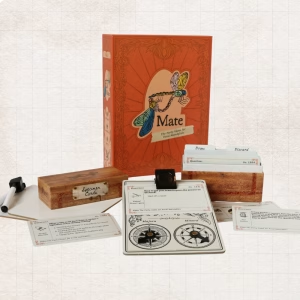




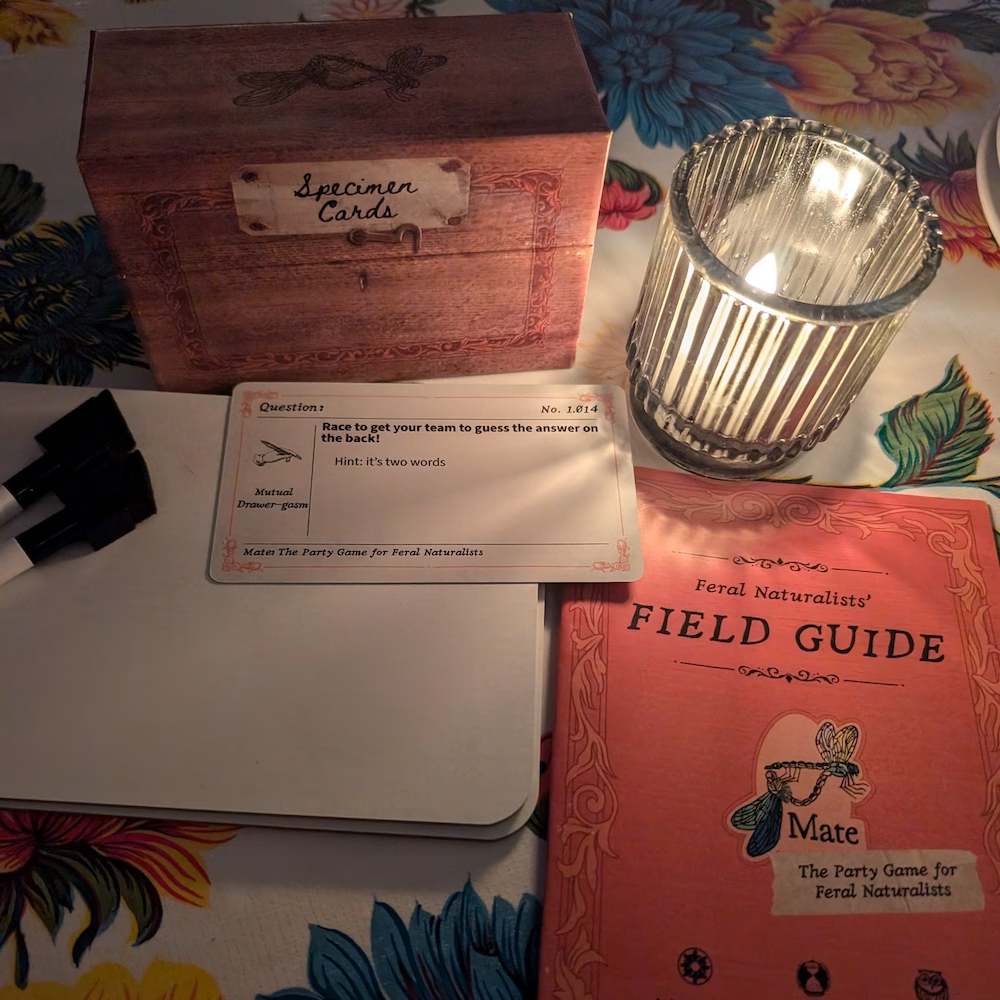
Mate: The Party Game for Feral Naturalists
Animal mating science meets party game fun. With your team of fellow feral naturalists, analyze specimens, answer queries, estimate measurements, and craft illustrations—all exploring animal mating behaviors and anatomy. For 4-8 players, ages 17 and up.