
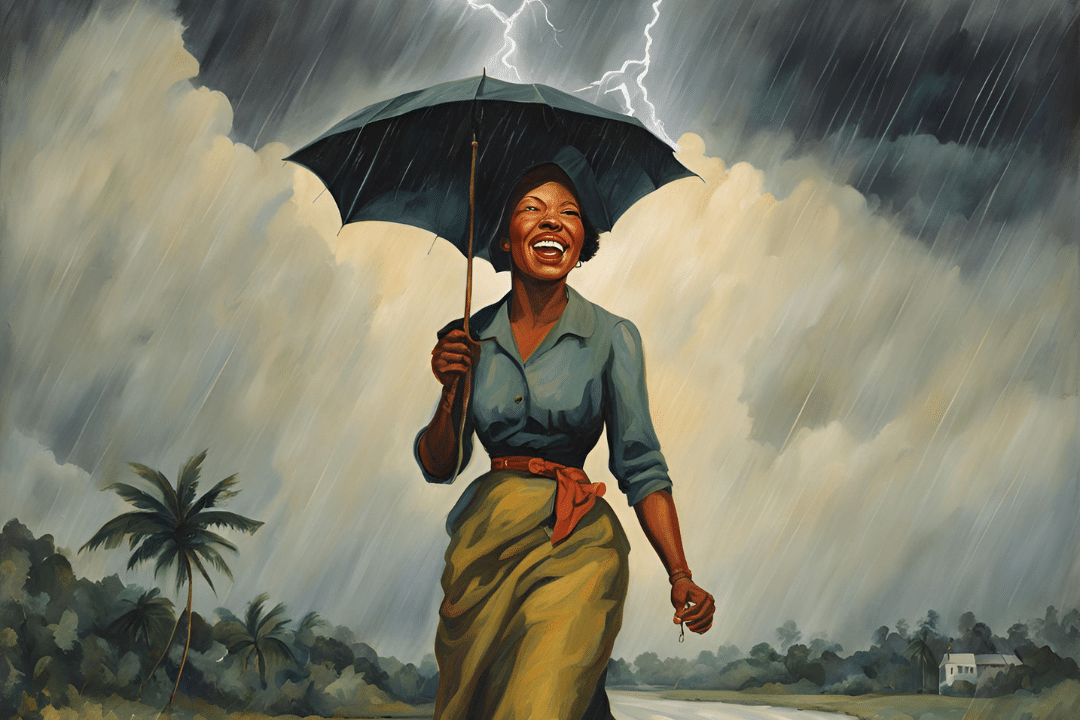
“I do not say that my conclusions about anything are true for the Universe, but I have lived many ways, sweet and bitter, and they feel right for me… I have walked in storms with a crown of clouds about my head and the zig zag of lightning playing through my fingers. The gods of the upper air have uncovered their faces to my eyes.”
Zora Neale Hurston
Important note: this post is going to focus on the field of anthropology, specifically within the western academic tradition and four individuals performing field work within it in the 1920s and 30s. All of these individuals did quite a bit to challenge and further the methods and practices within their profession. Their work and practices were also at times problematic. This post focuses on the good they did in helping humanity open their minds to different ways of living and thinking, but that’s not to minimize the harms they participated in or perpetrated. The book this post is based on (see additional reading below) covers these issues in detail. You can also check out this very good podcast for additional context.
Why are we here? What is our purpose? These questions often trouble humans, though most people focus on the personal. Like what is my calling—which in the western world means what job can you do that you actually like—which also makes you money? More significantly, it can also be specific to our gender and our sexuality. What am I supposed to be as someone who was raised to be a “man”, or a “woman”, as someone who’s expected to be athletic or strong. What is “strong.” How are we supposed to be?
Rural Pennsylvania had all these gender and sexual norms. They were spoken of in my town as though they were the fundamental laws of the universe. Etched in stone. Gifted by God. Even if people weren’t Christian, their social mores could be traced back to it. It’s easy to just accept that these normative behaviors are immutable truths. Everyone around me as a child agreed on them. No one in my social orbit stood around questioning the role men and women played in our society. There was no alternative. If you didn’t fit into their gender roles then you were othered.
And so as a young lad my parents and society told me exactly what I was supposed to be. My elders conveyed the dos and don’ts of life as immutable facts. No doubt appeared in their voice when telling me how I should be. Sometimes they’d cite their sources, which in my case was usually the Bible—though there was never any direct quotation or intimate knowledge of this holy source, just generalities. In reality their beliefs were an amalgam of the society they grew up in. A product of the cultural hegemony of Western capitalism.
White men (sorry y’all) hunt, are tough, strong, play sports, don’t show emotion. Just be super repressed and then later become an alcoholic to dull the pain of not being in touch with my emotions. Work hard above all else. This basically sums up the guidance I received. I was generally lucky. For the most part I was able to inhabit this idea of a man in my community, though I certainly didn’t like many elements, like hunting. Atrociously boring. But I had to do it. To not hunt in my community, as a “man” would have prompted all sorts of speculation amongst my peers and their parents. Others in my community were not so lucky. Queer folks suffered immensely.
Normative behaviors in human societies are constructed by human beings and are shaped by multiple factors—history, religion, geography, politics, economics. Most importantly, they are not universal, but can vary considerably from one culture to another. However, even today people often don’t think of them this way. They tend to think they are universal—or should be. There’s only one way to act or behave—our way. For Europeans at least this was the standard point of view for centuries. Intellectuals spent their time explaining why people should do this or that. There was no interest in questioning why we do this or that, at least until the 20th century.
Normative behaviors in human societies are constructed by human beings and are shaped by multiple factors—history, religion, geography, politics, economics. Most importantly, they are not universal, but can vary considerably from one culture to another.
A lot of the intellectual discourse in European, and European adjacent, societies spent time reinforcing their preferred norms, all the way into the 20th century. The encounter with indigenous societies during the age of exploration confronted Europe with people that had different ways of organizing society, constructing gender, and sharing wealth. Instead of questioning their own values when confronted with the ease of life exhibited by the Haudenosaunee, a matriarchal society in colonial New York, European men sought to justify an unjust social order to protect their role within it. Their privileged position in their society had to be defended and protected, not questioned. The defense continued well into the 20th century and still continues today. Thankfully a few enterprising individuals began the work of examining non-European societies and cultures, comparing them to Eurocentric norms, and raising some uncomfortable questions about what we believe and how we organize our society. Franz Boas is often credited with being one of the early pioneers in this work and also helping to create the modern field of anthropology.
At the time it was commonly accepted by early anthropologists that all human societies develop along the same teleological trajectory—from hunter gatherers, to tribes, to large civilizations or empires. Didn’t matter where or who, it was always the same. A universal theory that was embraced by many. Not a surprise. The theory justified Eurocentric views on what civilization and society should be. The endpoint, or the goal, of all human societies should look like western Europe or the U.S. This commonly held view in the West impacted museums at the time. Exhibits were organized by chronology, not by different cultures. If you walked into the Smithsonian or the Natural History Museum in New York around 1900 you’d view artifacts grouped together by stages of development, not by different peoples. Why have separate exhibits on Inuit and Chinese culture and history if we’re all headed to the same place? All stone tools would be in the same area despite the fact that they came from a diverse array of humanity and exhibited clear distinctions in design, construction, and purpose.
Franz, a German in case you didn’t pick up on it, first studied Inuit society and culture and then shifted his focus to the peoples of the Pacific Northwest. He immersed himself in the culture he was studying, a radical departure at the time. The immersion eventually led Franz to an epiphany. Humans aren’t on a unified trajectory toward Europe’s ideal of social organization. Every society is radically different based on where it develops and the other societies and cultures it is in dialog with. There isn’t a “correct” end point for people. It varies and the differences are not necessarily good or bad. They just are. This didn’t just apply to the stages of development, but also to systems of belief and social norms.
You might be surprised to learn that this new theory of human development didn’t receive a warm welcome amongst Franz’s colleagues. First of all it was relativistic, something that has scared the shit out of Western thinkers for centuries due the crushing influence of Aristotelian Christian theology. His effort to decenter Western values was heavily attacked. Telling those with power that your society isn’t based on immutable truths is never an easy proposition, but Franz persisted. He did so by establishing the anthropology department at Columbia University and by accepting women as students.
Telling those with power that your society isn’t based on immutable truths is never an easy proposition.
Mr. Boas had no reservations bringing women into his burgeoning anthropology department. In fact he felt it would benefit their research. Women had not been given a voice in academics. As a result anthropological research was missing the perspective and insight of half of humanity. Word started getting out that the head of the anthropology department at Columbia was a chill dude. Soon his department was dominated by women, one of whom was Margaret Mead.
Mead was born into a world utterly unsuited to her. She was a queer, polyamorous, career academic in the early 1920s, and her personal experience directly influenced her work, pushing her to initially examine how different cultures approach the experience of puberty. In her case she traveled to the south Pacific to study how youth come of age within various Pacific Islander cultures. As she suspected, it didn’t align in any way to the pubescent paradigm in the United States. Mead observed a completely different experience of adolescence and puberty for Samoan women. Within a village topics such as sex, birth, menstruation, death were out in the open. There were far less taboos around discussing these issues. Going through puberty was not a major issue for Samoan boys or girls, in stark contrast to the angst, confusion, and fear typically experienced by American children. Much to Franz’s satisfaction, Mead’s famous Coming of Age in Samoa demonstrated how social mores society takes for granted are highly variable and substantially a product of time and place, not immutable universal truths handed down from on high. (The influence of the Western gaze on Mead’s findings and her view of the island is a laboratory for research has been rightly criticized by Samoans. More on that in this excellent podcast series.)
The work Mead began in Samoa helped her realize that her sexual orientation was perfectly acceptable in other cultures. It just so happened that she was born into one that rejected it. She was a decent person who treated others with dignity, but because her sexuality didn’t align with the values of her society she was considered suspect by many of her fellow Americans. Her work continued to highlight the relative nature of social constructs. Coming of Age in Samoa turned into a surprise best seller and made Mead a household name, at least among rich educated people. She would later go on to become the curator of the Museum of Natural History in New York, spending decades teaching the public about the varied cultures and people on our planet. When you are in the museum today you’ll note that exhibits are organized by different cultures, not strictly by chronology.
Another luminary to come out of the Boas school was Ruth Benedict. She effectively ran the department and maintained an intimate relationship with Mead, one of the loves of her life. Her position with the department kept her abreast of all the innovative work being done. This put her into a position to synthesize the ideas being formulated, which turned into Patterns of Culture. Benedict argued that each culture has its own unique moral logic, which can place emphasis on vastly different values. This is a result of geography and interactions with adjacent cultures. It’s always different and it’s never “right” or “wrong.” Within a specific culture people will tend to embody and place emphasis on specific aspects of their culture over others, something she argued was a universal trait among humans. This is why we tend to see the role of shaman, priest, medicine doctor, sage, etc. appear in cultures across the planet.
Her most famous work was The Chrysanthemum and the Sword, a true best seller. Benedict was asked by the U.S. government to write a report on Japanese culture for the military. She immersed herself in her work and the result was an engaging, nuanced, illuminating portrait of Japanese society. In the wake of World War II it helped soften the racist American attitude toward Japanese folks and positively influenced the U.S. approach to Japanese reconstruction after the war. Her goal was to understand a different culture and not judge it. She hoped in doing so Americans would follow suit and hopefully realize that all cultures have something to offer, not just their own.
Benedict and Mead’s success coming out of Franz’s department was more the exception than the norm unfortunately. Zora Neale Hurston was another of Boas’ students. A Black woman from the deep south, she may have been his most brilliant pupil. A leading intellectual of the Harlem Renaissance, Hurston’s anthropological work focused on Black culture in the deep south as well as the Caribbean. She helped catalog the folklore of African American cultures as part of the New Deal’s Federal Writers’ Project.
Hurston’s Tell My Horse was a mix of anthropology personal travel narrative that came out of her field work studying cultural rituals in Jamaica and Haiti. One of the main aims of this work was to properly contextualize voodoo, which had first been written about by white authors who sensationalized and often denigrated the spiritual practice. She showed that voodoo served a purpose within the communities she studied and was often a means of making sense of a difficult existence. She did not judge what to her was initially an incomprehensible system of beliefs.
“I did not find them any more invalid than any other religion. Rather, I hold that any religion that satisfies the individual urge is valid for that person. It does satisfy millions, so it is true for its believers.” — Zora Neale Hurston
Sadly Hurston did not have the success of Mead or Benedict. She struggled to gain a wider audience as a Black woman. Her literary work fell out of favor due to her use of African-American dialect. She wanted to portray Black people as they were, struggling to survive in a white supremacist society. This depiction was not favored by many of her peers, like Richard Wright, who felt her depiction of Black people validated racist white views toward Black people. It wasn’t until nearly a decade after her death in 1960 that her work was reassessed as an intimate, realistic portrait of Black life in the American south. This is best reflected in the rediscovery and celebration of Hurston’s novel Their Eyes Were Watching God. Her academic work and fiction helped show how Black people developed cultural systems to find hope and agency under a repressive social system.
All of these people observed other societies and their culture and drew what should be a simple conclusion to accept for all of us—that our mores and beliefs are relative. Each culture is a product of circumstance. They do share some universal traits, often centering on human dignity, but otherwise can be quite different. And crucially that’s OK. There isn’t one society, one culture, that has figured everything out. We are flawed creatures. Sometimes we get things right. Sometimes we don’t. These authors wanted us to understand and accept this. To acknowledge that your culture is relative and as such isn’t necessarily perfect. Accepting this makes us more humble, emphatic, understanding, and curious.
These authors wanted us to understand and accept this. To acknowledge that your culture is relative and as such isn’t necessarily perfect. Accepting this makes us more humble, emphatic, understanding, and curious.
This is the goal of Mate: The Party Game for Feral Naturalists. To challenge preconceived beliefs about nature and sex in the animal world, which are often a product of European values. Not all societies are dominated by men. Not all societies have two genders, but dozens. Not all societies are based on the accumulation of wealth. Not all societies demonize queerness. We are living in a time when part of our society is trying to force a specific view of Christian, European culture on all people. It’s more important than ever to question why we believe what we do. So why not open yourself up to different ways of thinking about how the world should be? There’s lots to learn. Check out the above authors and the book Gods of the Upper Air by Charles King, which this was all based on. Also check out Mate.
