

As a young girl, I learned early who mattered in science. “The male mallard duck, called a drake, sports a glossy green head, a white ring around its neck and a rich, chestnut-brown breast,” National Geographic Kids explains. “The mottled brown female mallard looks downright dull next to the male’s showy feathers” (emphasis added). The message was clear and everywhere: males are the showy spectacle; females are the side character, muted and unremarkable.
I was fortunate to encounter female-centered science earlier than most, though it came framed almost entirely through suffering—the damsel (err, duck) in distress. My high school biology teacher had worked in a lab studying cortisol levels in female ducks after forced copulation. I remember sitting frozen at my desk as he described the experiment: after mating, the ducks were killed, their brains sliced into thin sections, and examined under microscopes to confirm that the experience was stressful.
In college, ducks reappeared—this time as punchlines. By then, many people knew about the corkscrew-shaped penis of male ducks and their aggressive mating behavior. Drakes won awards for their strange anatomy. Internet jokes proliferated. “Duck r*pe” became a recurring gag, offered up as proof that male violence was natural, inevitable, even amusing when cloaked in biology.
“Duck r*pe” became a recurring gag, offered up as proof that male violence was natural, inevitable, even amusing when cloaked in biology.
I loved being able to push back, to point out that researchers had documented how stressful this was for females. And that joking about even duck r*pe contributes to a culture of violence. But even then, the story centered on males, on what they did, how strange they were, how shocking their anatomy appeared. What I didn’t yet know was that the story I’d been told—of dull females and dominant males—was not only incomplete, but wrong.
That realization came years later, while researching Mate: The Party Game for Feral Naturalists. What started as a pandemic-fueled curiosity—learning about animal mating behavior while others made sourdough—slowly turned into a reckoning with how deeply sexist our scientific narratives are. To write the questions for the game, I began reading widely: Lucy Cooke’s Bitch: On the Female of the Species, Rachel Gross’s Vagina Obscura, and the work of scientists who had been challenging male-centered biology for decades.
That’s how I found Dr. Patty Brennan. Brennan, an evolutionary biologist and professor, studies the diversity of genital structures across species—snakes, birds, sharks—but one of the most radical aspects of her work is simply that she studies female anatomy with the same seriousness long afforded to males.
For decades, the drake’s corkscrew penis has dominated discourse. Google search trends reflect this obsession: “duck penis” remains widely searched, while “duck vagina” is largely ignored. Male anatomy is treated as fascinating, museum-worthy, and record-breaking. Female anatomy is framed as incidental, if it’s mentioned at all. Brennan is changing that. Female ducks have labyrinthine vaginal canals, complex corkscrew structures that twist and turn. These vaginas contain dead ends and pockets designed to redirect unwanted sperm.
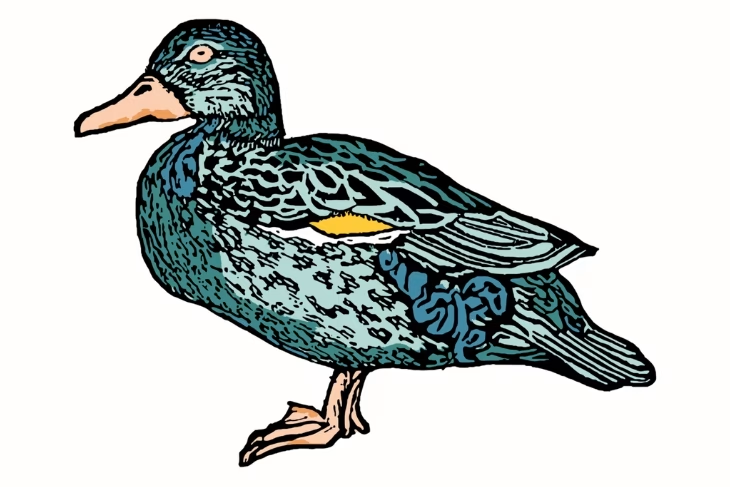
And they work! Scientists have found that female ducks control paternity over 95% of the time. Even when forced copulation occurs, females retain extraordinary agency over which male actually fertilize their eggs. Through muscle contractions, positioning, and timing, they choose. This anatomy evolved alongside male aggression. It is not evidence of female weakness, but of female resistance. As Brennan told El País: “It’s incredible. It’s a very feminist story… At the end of the day, the females are winning the battle. They evolved an adaptation which gives the majority of paternity to the male that they have chosen.”
“It’s incredible. It’s a very feminist story… At the end of the day, the females are winning the battle.”
Dr. Patty Brennan, El País
Learning this fundamentally changed how I understood biology, and why Mate exists at all. The game was born from the dissonance between what we’re taught about nature and what the science actually shows when we bother to look at females. It came from wanting to share these stories—the weird and funny truths about animals—in a way that feels accessible and joyful.
Because the problem isn’t just that female ducks were misrepresented. It’s that science itself has been shaped by whose bodies are seen as interesting and worthy of study. The blue whale’s penis has its own Wikipedia page. Iceland boasts a national phallic museum. Barnacles are celebrated for genitals eight times their body length. Male ducks hold Guinness records. Across studies on genital evolution published between 1989 and 2013, nearly half examined only males. Fewer than ten percent focused exclusively on females.
The problem isn’t just that female ducks were misrepresented. It’s that science itself has been shaped by whose bodies are seen as interesting and worthy of study.
By insisting on studying vaginas—by naming them, mapping them, taking them seriously—scientists like Brennan expose how bias masquerades as objectivity. They show that sexual selection is not a one-way story of male dominance and flamboyance, but a complex dialogue between bodies and behaviors co-evolving over time. When planning the art for Mate, I knew I wanted it to feature a female duck with a visible corkscrew vagina—quite the opposite of the “downright dull” side character I met as a child. She stands as a reminder that they were always there, twisting and turning, refusing to be reduced.
The dullness was never in the animals. It was in the stories we chose to tell, and the ones we’re finally unlearning.

Tenacity print
Female ducks evolved twisting anatomy, tenaciously fighting back to shape their future.